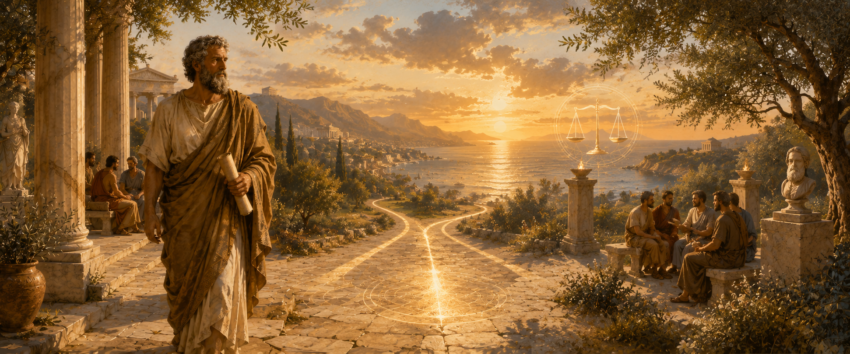
Book Title: Nicomachean Ethics
Author: Aristotle (384-322 BC). Greek philosopher. Student of Plato. Tutor to Alexander the Great. Founded the Lyceum. Wrote on logic, biology, politics, ethics, and more.
Published: c. 340 BC. Named for his son Nicomachus or his father. Written as lecture notes.
Category: Philosophy, Ethics, Virtue Ethics, Classical Literature
Table of Contents
- 1. Book Basics
- 2. The Big Idea
- 3. The Core Argument
- 4. What I Liked
- 5. What I Questioned
- 6. One Image That Stuck
- 7. Key Insights
- 8. Action Steps
- 9. One Line to Remember
- 10. Who This Book Is For
- 11. Final Verdict
- 12. Deep Dive: The Doctrine of the Mean
- 13. Deep Dive: Virtue and Habit
- 14. Deep Dive: Friendship
- 15. Deep Dive: Comparison to Stoicism
- 16. Final Reflection: The Good Life as Craft
1. Book Basics
Why I picked it up:
Nicomachean Ethics asks the oldest question. What is the good life? What should I aim at? How should I live?
Aristotle had credentials. He studied under Plato for 20 years. He taught Alexander. He studied animals, politics, and the soul. He wanted facts, not myths. He looked at how people actually live. Then he asked what makes life go well.
The book addresses the problem of happiness. The Greek word is eudaimonia . It means living well. It means flourishing. Most people think happiness is pleasure. Or money. Or honor. Aristotle says those fail. They are not ends. They are means.
The central thesis is this: The good for man is activity of the soul in accord with virtue. In a complete life. Happiness is not a feeling. It is an activity. It is using reason well. It is having a good character. It needs friends. It needs some externals. But the core is virtue.
This book is different from Plato. Plato looks up to Forms. Aristotle looks at men. Plato asks what Justice is. Aristotle asks what a just man does. Plato wants the ideal. Aristotle wants the human. He gives a method. Find the mean. Practice it. Become it.
Expect 10 books. The style is lecture. It defines. It divides. It argues. It gives examples. It is dry. It is dense. It is systematic. Read slow. Take notes. It rewards work.
2. The Big Idea
The core premise is that every action aims at some good. The chain must end. There must be a highest good. That good is happiness. All want it for itself. We want money for happiness. We want honor for happiness. We want happiness for nothing else.
The problem is false ends. People aim at pleasure. Pleasure is animal. People aim at honor. Honor depends on others. People aim at money. Money is a tool. None of these are final. None are self sufficient.
The book offers a reframe. Look at function. A knife is good when it cuts well. A flute player is good when he plays well. What is man’s function? Not life. Plants have that. Not perception. Animals have that. It is reason. So the good for man is reason used well.
Conventional wisdom says virtue is rules. Aristotle says virtue is habit. It is a state of character. It lies in a mean between excess and defect. Courage is the mean between rashness and cowardice. Generosity is the mean between waste and stinginess. You hit the mean by practice.
The fundamental insight is that you become just by doing just acts. You become brave by doing brave acts. Virtue is not taught. It is trained. Like a lyre player. You learn by playing. You learn by feedback. You need a teacher. You need habit. You need time.
What changes:
Your view of ethics shifts. Ethics is not rules. Ethics is skill. You are not good or bad. You are skilled or unskilled at living. You can train.
This reframe affects choices. You stop asking, is this allowed? You ask, what kind of person does this make me? You ask, what is the mean here? You look at yourself as a craft.
This matters beyond school. Doctors use it. Soldiers use it. Parents use it. Business uses it. Any role has a virtue. Find the mean. Practice. Become good at being human.
3. The Core Argument
Argument 1: The good is activity of soul in accord with virtue. Not state. Not feeling. Activity. In a complete life. One swallow does not make a summer. One day does not make a man happy. Book 1.
Argument 2: Virtue is a mean between two vices. Excess and defect. Courage is between rashness and cowardice. Temperance is between self indulgence and insensibility. Find the mean relative to us. Not arithmetic. Book 2.
Argument 3: Virtue is voluntary. You choose it. You are not forced. You deliberate. You decide. You act. Children and animals do not have virtue. They do not choose. Book 3.
Argument 4: Particular virtues exist. Courage. Temperance. Liberality. Magnificence. Magnanimity. Right ambition. Gentleness. Friendliness. Truthfulness. Wit. Justice. Each has its mean. Each has its field. Books 3 to 5.
Argument 5: Justice is special. It is the whole of virtue in relation to others. It is also a part. It has its own mean. It is fairness. It is lawfulness. Book 5.
Argument 6: Intellect has virtues. Art. Science. Prudence. Wisdom. Understanding. Prudence is reason about action. Wisdom is reason about truth. Prudence rules life. Wisdom rules thought. Book 6.
Argument 7: Weakness of will exists. Akrasia . You know the good. You do the bad. Why? Appetite pulls. Knowledge is not active. The last premise is not used. So you act against knowledge. Book 7.
Argument 8: Pleasure completes activity. It is not the goal. It is like bloom on youth. Good activity has pleasure. Bad activity has pain. Pick activities, not pleasures. Book 7 and 10.
Argument 9: Friendship is necessary for happiness. Three kinds. Utility. Pleasure. Virtue. Only virtue friendship lasts. Good men are friends because of good. They help each other be good. Books 8 and 9.
Argument 10: The best life is contemplation. Reason is highest in us. Its use is highest. The gods do this. We share it. So it is most happy. But we are human. We need ethics too. Book 10.
4. What I Liked
Strength 1: The mean is practical. It is not rule. It is target. You aim. You adjust. Too much. Too little. Try again. Like archery. You can do it.
Strength 2: He starts with facts. He looks at how people live. He names virtues people praise. Courage. Generosity. He does not invent. He clarifies. That grounds the book.
Strength 3: He links ethics to politics. Ethics makes good men. Politics makes good cities. One needs the other. The book ends by opening Politics . The two are one study.
Strength 4: He respects externals. You need some health. Some money. Some friends. Virtue is not enough alone. Priam was good. He was not happy when Troy fell. That is honest.
Strength 5: He honors friendship. Books 8 and 9 are on friends. He says no one would choose to live without friends. Even with all goods. That is human. That is true.
Strength 6: He defines happiness as activity. Not mood. Not luck. Work. Use reason. Use it well. All your life. That puts power in your hands.
5. What I Questioned
Limitation 1: The mean is vague. What is the mean? He says it is relative to us. A trainer gives each athlete different food. So the mean shifts. How do I find it? He says with a wise man. Who is wise? Circle.
Limitation 2: The book is for free men. Slaves, women, and workers are not in view. The virtues need leisure. Need money. Need education. The poor cannot practice. The book assumes a class.
Limitation 3: He is harsh on others. Natural slaves exist, he says. Some men are born to be ruled. Women are incomplete. That stains the book. We reject it now.
Limitation 4: Contemplation wins. Book 10 says the best life is study. But the rest of the book is on ethics. Action. Why end with study? It feels added. It feels elitist.
Limitation 5: He lists virtues. He does not prove them. Why these? Why not others? He says they are praised. That is culture. That is not argument. The base is weak.
Limitation 6: The book is dry. No stories. Few examples. Many divisions. It reads like notes. Because it is notes. You must add the life yourself.
6. One Image That Stuck
The Archer
Aristotle uses this in Book 1 and 2. Every craft has an end. The archer has a target. He aims. He shoots. If he hits the mark, he is good. If he misses, he adjusts.
Life is the same. Happiness is the target. Virtue is the aim. The mean is the bullseye. You do not hit it once. You shoot many times. You adjust each shot. Wind blows. Hand shakes. You learn.
He says in Book 2: Virtue is a mean between two vices. Like a target between too far and too short. The brave man feels fear. He feels confidence. He stands. The coward feels too much fear. The rash feels too little. The brave feels the right amount, at the right time, for the right reason.
The image works because all men know aim. You have tried. You have missed. You have learned. The body knows this. The mind can use it.
This image reframes the book’s insight. Ethics is not rule. Ethics is skill. You are not born good. You are not born bad. You are born with a bow. You must practice. You must get feedback. You must aim.
The image teaches without guilt. Missed? Shoot again. That is the path. Not perfection. Not law. Practice.
7. Key Insights
- Happiness is activity, not state. One day does not make a man happy. One act does not make him good. A whole life does. Keep acting. Book 1.
- Virtue is habit. We become just by doing just acts. We become brave by doing brave acts. Do not wait to feel brave. Act brave. Feeling follows. Book 2.
- The mean is relative to us. Ten pounds of food is too much for a beginner. Too little for Milo. The mean is not half. It is what reason says. Ask a wise man. Book 2.
- Choice is desire plus reason. Animals have desire. Children have desire. Man has choice. He thinks. He wants. He acts. That is virtue’s field. Book 3.
- Courage faces fear for the right reason. The rash man does not fear. The coward fears all. The brave man fears what he should. Death in battle. He stands. Book 3.
- Liberality is about giving. Take and give. The mean is to give to the right people. The right amount. At the right time. With pleasure. Waste is excess. Stingy is defect. Book 4.
- Magnanimity is the crown. The great soul claims much and deserves much. He is above insults. He does not remember wrongs. He helps. He does not ask. Few can be this. Book 4.
- Justice is the whole of virtue to others. In relation to self, virtues differ. In relation to others, justice holds all. It is fairness. It is lawfulness. Book 5.
- Prudence rules. Wisdom knows truth. Prudence knows action. You need both. But to live, you need prudence. It tells you what to do here, now. Book 6.
- Friendship holds cities. Law holds them less. Friends want the good for the other. In virtue friendship, each makes the other better. That is the best. Book 8.
8. Action Steps
Start: Find the mean. Use when: You face a choice. The Practice:
- Name the field. Fear? Anger? Money?
- Name the excess. Rash? Irascible? Wasteful?
- Name the defect. Cowardice? Spiritless? Stingy?
- Ask, what would the wise man do?
- Do that. Why it works: Aristotle says virtue is a mean. Naming the extremes shows the target. You aim better.
Stop: Calling it all or nothing. Use when: You fail once. The Practice:
- You missed the mean.
- Say, one shot missed.
- Adjust. Shoot again.
- Do not say, I am a coward. Say, I acted cowardly then. Why it works: Character is habit. One act is not you. Ten acts start to be. You can change.
Try for 10 Weeks: One virtue a week. Use when: You want to grow. The Practice: Week 1: Courage. List fears. Face one small. Week 2: Temperance. Note pleasures. Pick one to moderate. Week 3: Liberality. Give to the right person. Week 4: Gentleness. Slow anger. Count to ten. Week 5: Truthfulness. Avoid lies. Avoid boast. Week 6: Wit. Joke without hurting. Week 7: Friendliness. Listen more. Week 8: Justice. Keep a promise. Pay a debt. Week 9: Prudence. Deliberate before act. Week 10: Contemplation. Read 10 minutes. Think. Why it works: Aristotle says we become by doing. Ten weeks. Ten habits. What you’ll notice by week 10: You see the mean faster. You act before feeling. You are more skilled at life.
9. One Line to Remember
“Happiness is activity of the soul in accord with virtue in a complete life.”
Or: “We are what we repeatedly do. Excellence, then, is not an act but a habit.”
Or: “Virtue lies in a mean between two vices.”
10. Who This Book Is For
Good for: Students of ethics. People who want a method, not rules. Leaders. Parents. Anyone building character. Anyone tired of feelings based advice.
Even better for: People with some life experience. The young cannot use it, Aristotle says. They lack experience. You need to have failed. Then you read. Then you see.
Skip or read critically if: You want fast answers. You want stories. You want God. You need emotion. Read it with a journal, not a highlighter, if that is you.
11. Final Verdict
Nicomachean Ethics is the root of virtue ethics. Its greatest strength is method. Find the mean. Practice it. Become it. That works. You can do it.
Its greatest limitation is class. It assumes leisure. It assumes money. It assumes male citizens. The poor cannot practice magnificence. The slave cannot practice magnanimity. The book is not for all.
The book accomplishes this: It makes ethics a craft. You are not good. You get good. Like a flute player. Like a builder. That puts power in your hands.
It does not accomplish this: It does not tell you the mean. You must find it. It does not give steps. You must live. It is a map with no roads. You walk.
You will benefit most if you act. You will lose if you only read.
The lasting impact is this: After Aristotle, ethics had a path. Not law. Not god. Habit. Reason. Mean. The book delivers on its promise. It shows the good life. It says you must work for it. The work is the life.
12. Deep Dive: The Doctrine of the Mean
What the Mean Is Not
The mean is not average. It is not 5 between 0 and 10. It is not compromise. It is not lukewarm. It is the right amount. Milo the wrestler needs more food than a beginner. The mean for him is more. The mean is relative to the person and the situation.
How to Find It
1. Feel the extremes. You must know excess and defect. You cannot aim if you do not see the sides. Be rash once. Be cowardly once. Note the feel. Then aim between.
2. Note your bias. We lean to one side. Some men lean to anger. Some to fear. Pull to the opposite. If you lean to pleasure, pull to pain. You will land in the middle. Book 2.
3. Use the wise man. The mean is what the wise man would do. Find one. Watch him. Ask him. If none, use reason. What does the situation ask? Not what do you feel.
4. Check for pleasure. We like the excess. The rash man likes the charge. The coward likes safety. The brave man likes the act. If you like it, suspect excess. If you dread it, suspect defect. The mean is often hard.
Examples
Courage. Fear of death in battle is right. No fear is rash. Too much fear is cowardice. The brave man feels fear. He stands. He chooses noble over safe.
Temperance. Pleasure in food is right. No pleasure is insensible. Too much is self indulgent. The temperate man enjoys. He stops. He is not ruled.
Liberality. Giving money is right. Give too much, you waste. Give too little, you are stingy. Give to the right person. The right amount. At the right time. With pleasure.
Modern Use
Manager must praise. Too much, he is flatterer. Too little, he is cold. The mean is honest praise, when due. Parent must discipline. Too much, tyrant. Too little, neglect. The mean is firm and kind. You find it by doing. You miss. You adjust.
13. Deep Dive: Virtue and Habit
How Habit Works
Book 2 says we are made of nature, habit, and teaching. Nature gives capacity. Habit makes it. Teaching shows it. Nature gives us sight. Habit makes us see well. Teaching tells us what to look for.
Virtue is habit. You do just acts. You become just. You do not become just, then act. The act comes first. The state follows. Like building. You build to be a builder. You do not build because you are a builder.
Steps to Build Habit
1. Start small. Do not try to be magnanimous. Try to be truthful in one talk. Habit needs wins. Small wins stack.
2. Repeat. One act does not make a habit. Many do. Like a lyre player. Scales daily. Then songs. Then skill.
3. Feel pleasure. The sign of habit is pleasure in the act. The brave man likes battle. The temperate man likes restraint. At first it hurts. Later it pleases. That is proof.
4. Get feedback. The wise man corrects you. Pain corrects you. Shame corrects you. Use it. Do not avoid it.
5. Last long. One swallow does not make a summer. One day does not make a habit. A complete life does. Keep going.
Why Most Fail
They wait for feeling. I will give when I feel generous. You never will. Act generous. Feeling comes. They want rules. Do not lie. That is easy. Aristotle says when to lie is hard. That needs habit. They want fast. Habit is slow. They quit.
14. Deep Dive: Friendship
Three Kinds
1. Utility. You are friends because you help each other. Business partners. Classmates. When use ends, friendship ends. It is common. It is not high.
2. Pleasure. You are friends because you enjoy each other. Wit. Beauty. Fun. When pleasure ends, friendship ends. Young people have this. It fades.
3. Virtue. You are friends because you are good. You wish good for the other for his sake. You help him be good. This lasts. It is rare. It needs time. It needs trust.
Why Friendship Matters
No one would choose to live without friends. Even with all goods. Man is social. Happiness needs others. Friends are another self. You see yourself in him. You act better for him.
Friends hold cities. Law holds less. When men are friends, they need no justice. When men are just, they still need friends.
How to Be a Friend
Wish good for the other. For his sake. Not yours. Share joy. Share grief. Live together. Talk. Act. Distance breaks it. Use breaks it. Virtue keeps it.
You cannot have many virtue friends. They take time. One or two. That is enough. That is life.
15. Deep Dive: Comparison to Stoicism
Key Differences
Aristotle: Happiness needs externals. Some health. Some money. Some friends. Priam was good. He was not happy when Troy fell.
Stoics: Happiness needs virtue only. The sage is happy on the rack. Externals are indifferent. Priam can be happy if he keeps will.
Aristotle: Emotion is part of virtue. The brave man feels fear. He masters it. He does not erase it.
Stoics: Emotion is judgment. Erase judgment. Erase emotion. The sage feels no fear.
Aristotle: The mean is between feelings. Right amount of anger. Right amount of love.
Stoics: Extirpate passion. Use reason only. No mean. No feeling.
Aristotle: The best life is contemplation. But also politics. Man is social. Act.
Stoics: The best life is virtue. You can have it in a cell. Act if you can. But you do not need to.
Which to Use When
Use Aristotle when you live in the world. You have a job. You have a family. You need to act. You need to feel. You need friends. He gives you a path.
Use Stoics when the world takes all. You are in prison. You are sick. You are exiled. You have only will. They give you a path.
Aristotle is for building. Stoics are for enduring. You need both. Build when you can. Endure when you must.
16. Final Reflection: The Good Life as Craft
Aristotle ends Book 10 by opening Politics . Ethics is not enough. You need laws. You need a city. You need friends. The good life is not solo. It is with others. It is in a city.
The overarching theme is craft. The flute player becomes good by playing. The builder by building. The man by living. You are not born good. You become good. Or not.
The book’s contribution is measure. It gives you a ruler. The mean. It gives you a method. Habit. It gives you a goal. Activity of soul in accord with virtue. That is enough to start.
The balance is this. The book does not make you good. You make you good. It shows the way. You walk. It shows the target. You shoot. It shows the mean. You aim.
The deeper lesson is about time. One day does not count. One act does not count. A life counts. Be patient. Be steady. Be kind to yourself when you miss. Shoot again.
A memorable closing thought: The last line of Nicomachean Ethics says, let us begin. After ten books, he says begin. The work is ahead. The work is life.