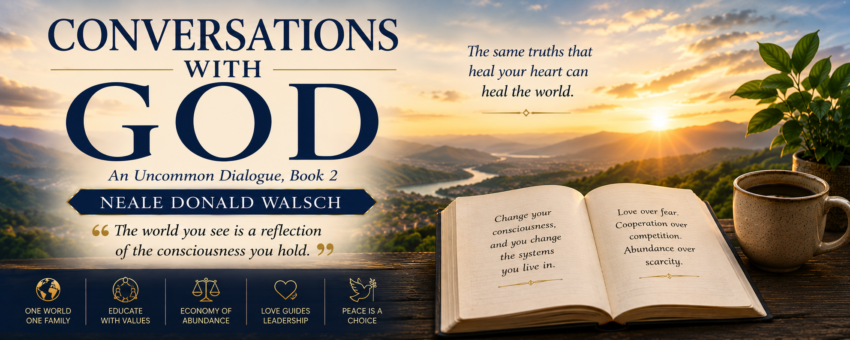
Book Title: Conversations with God: An Uncommon Dialogue, Book 2
Author: Neale Donald Walsch. American author who presents this as the continuation of his written dialogue with God, moving from personal to global questions.
Published: 1997
Category: Spirituality. Religion and Philosophy. Society and Culture.
Table of Contents
- 1. Book Basics
- 2. The Big Idea
- 3. The Core Argument
- 4. What I Liked
- 5. What I Questioned
- 6. One Image That Stuck
- 7. Key Insights
- 8. Action Steps
- 9. One Line to Remember
- 10. Who This Book Is For
- 11. Final Verdict
- 12. Deep Dive: From Personal to Global, the Series Shift
- 13. Deep Dive: Criticism and Reception
1. Book Basics
Why I picked it up:
Conversations with God Book 2 continues the dialogue started in Book 1, but shifts the scope from personal spiritual questions to global and societal ones.
Neale Donald Walsch had already gained a large following from Book 1. In this second volume, he expands the conversation to cover topics like politics, economics, education, sexuality, and humanity’s place in the wider universe.
The book addresses a broader problem than the first volume. Instead of asking why one person suffers, it asks why human society as a whole struggles with conflict, inequality, and division.
Its central promise is that the same spiritual principles from Book 1, centered on love over fear, can be applied to fix systemic, global problems.
Readers should expect the same question and answer dialogue format as Book 1, but applied to larger scale topics rather than personal crisis.
2. The Big Idea
The core premise is that humanity’s global problems come from the same root cause as personal suffering. Fear based thinking, applied at scale, creates broken systems.
The book identifies a problem with how society is currently organized. Walsch argues that politics, economics, and education are built around fear, scarcity, and control rather than love and cooperation.
The paradigm shift offered is this: if individuals can move from fear based thinking to love based thinking, society’s larger systems can be redesigned around cooperation instead of competition and control.
Conventional wisdom treats politics, economics, and education as separate, technical fields best solved with policy and expertise. The book argues these fields cannot be fixed without first addressing the underlying spiritual and emotional assumptions behind them.
The fundamental insight offered is that systemic change requires a shift in collective consciousness, not just new laws or institutions.
What changes:
Readers start to see global issues, such as economic inequality or political conflict, as expressions of a shared inner fear rather than only external, technical problems.
This reframe affects how readers engage with news and social issues, encouraging a search for the underlying fear or scarcity belief behind a given conflict.
This matters because it connects personal spiritual growth to social responsibility, framing inner change as relevant to outer, global problems.
3. The Core Argument
- Global problems mirror personal fear: The book argues that scarcity, competition, and conflict at a societal level trace back to the same fear based thinking discussed in Book 1.
- Economic systems built on scarcity create division: Walsch critiques economic systems that assume resources must be fought over, arguing this assumption itself creates inequality.
- Education should teach who we are, not just what we know: The book argues that schools focus on facts and skills while neglecting deeper questions of identity, values, and purpose. It proposes replacing part of the standard curriculum with values based courses, such as conflict resolution, self awareness, tolerance, and ethical economics.
- Sexuality is treated with less shame and more openness: The book challenges fear and guilt based views of sexuality, extending its broader theme of moving from fear to love into this area of life.
- Political systems reflect collective belief, not fixed necessity: The book argues that political structures can change as collective consciousness shifts toward cooperation over control. It goes as far as describing a possible unified world government with a Congress of Nations, funded through voluntary contribution, as one long term possibility.
- Humanity is part of a larger universal context: The book discusses humanity’s place among other forms of life and intelligence, framing Earth as one part of a much larger picture.
- Love based systems are possible at scale: The book argues that cooperation, rather than competition, can become the organizing principle for economics and politics if enough individuals shift their thinking.
- Collective change begins with individual choice: The book repeatedly returns to the idea that large scale change starts with individuals choosing love over fear in their own lives.
4. What I Liked
- Ambitious scope: The book tackles large, difficult topics like economics and politics through a spiritual lens rather than avoiding them.
- Consistent framework: It applies the fear versus love framework from Book 1 in a structured way across new subject areas.
- Encourages systems level thinking: The book pushes readers to look past individual blame and consider the deeper assumptions behind social problems.
- Connects the personal to the global: It offers a clear link between everyday spiritual practice and broader social responsibility.
- Willingness to address taboo topics: The book engages directly with subjects like sexuality and political conflict rather than staying purely abstract.
- Maintains accessible language: Despite the larger scope, the book keeps the same plain spoken, conversational tone as Book 1.
5. What I Questioned
- Highly ambitious claims with little practical detail: The book proposes large scale societal change but offers few concrete steps for how individuals or institutions might achieve it.
- Political and economic claims go beyond spiritual territory: Some readers and critics argue the book moves from spiritual reflection into political opinion without the same grounding it claims for its spiritual content.
- Same unverifiable premise as Book 1: The book still presents itself as a literal transcription of God’s words, which readers must accept largely on faith.
- Risk of oversimplifying complex global issues: Framing economic inequality or political conflict purely as expressions of fear can understate the role of history, power, and structural factors.
- Less personal and relatable than Book 1: By shifting to global topics, the book loses some of the intimate, personal tone that made the first volume resonate with many readers.
- Controversial content on sexuality and social norms: Some of the book’s positions on sexuality and social structure have drawn criticism from readers with more traditional views.
6. One Image That Stuck
Humanity Viewed From Outside Itself
The book repeatedly asks readers to imagine looking at human society from a distant, outside perspective, as though observing it without personal attachment to any one nation, religion, or economic system.
This image works by creating distance. It asks readers to notice patterns in human behavior, such as competition over scarce resources, that are harder to see from inside a single culture or system.
The image reframes global conflict as a shared human pattern rather than a problem belonging to any one group. It illustrates the book’s central claim that societal problems stem from a shared psychological root, not isolated political failures.
7. Key Insights
- Scarcity is treated as a belief, not just a fact. The book argues that assuming resources are inherently scarce shapes economic systems toward competition rather than cooperation.
- Fear based systems tend to reproduce themselves. Institutions built on fear, such as certain economic or political structures, are described as self-reinforcing over time.
- Education is framed as incomplete without self-knowledge. The book argues that teaching facts without addressing identity and values leaves people unprepared for larger life questions.
- Sexuality is reframed away from shame. The book challenges guilt based views of sexuality as another expression of fear based thinking applied to the body.
- Political structures are described as changeable, not fixed. The book presents current political systems as products of collective belief, which means they can shift as belief shifts.
- Humanity’s problems are framed as symptoms of a deeper pattern. War, inequality, and conflict are treated as expressions of the same fear based root cause discussed throughout the series.
- Cooperation is presented as more natural than competition. The book argues that competition is a learned response to scarcity belief, not an unavoidable feature of human nature.
- The book widens its lens beyond Earth. It discusses humanity’s place among a larger context of life and intelligence, extending the series beyond a strictly human centered view.
- Collective consciousness is treated as a real, shifting force. The book argues that widespread shifts in belief can meaningfully change how societal systems function over time.
- Individual choice is still the starting point for global change. Despite its broader scope, the book consistently returns each large scale idea back to individual daily choices.
8. Action Steps
Start: Trace Global Issues Back to Fear or Love
Use when: You are following news or a social issue that feels overwhelming.
The Practice:
- Identify the specific conflict or problem you are reading about.
- Ask what underlying fear, such as scarcity or loss of control, might be driving it.
- Consider what a love based or cooperative response to the same situation might look like.
Why it works: This applies the book’s core framework to real world issues, keeping the reader engaged rather than overwhelmed.
Stop: Assuming Scarcity Without Question
Use when: You catch yourself thinking there is not enough of something, such as time, money, or opportunity.
The Practice:
- Notice the scarcity thought as it arises.
- Ask whether the scarcity is truly fixed, or shaped by a system or belief.
- Look for one small way to act from abundance instead, such as sharing a resource or opportunity.
Why it works: This interrupts automatic scarcity thinking and opens space for a more cooperative response.
Try for 3 Weeks: Apply the Framework to a Social Issue
Use when: You want to explore the book’s societal ideas in a structured way.
The Practice:
- Week 1: Choose one social or political issue you care about and write down the fear based assumptions underlying it.
- Week 2: Research one example of a cooperative or love based approach to that same issue, from any source.
- Week 3: Identify one small personal action that reflects a shift from fear to cooperation on that issue.
Why it works: This mirrors the book’s own move from personal reflection to broader societal application in a manageable, structured way.
What you’ll notice by the end of 3 weeks: A clearer personal framework for engaging with difficult social issues without feeling powerless.
9. One Line to Remember
The book’s overall message, paraphrased rather than quoted directly, is that the same choice between fear and love that shapes an individual life also shapes the systems humanity builds together.
10. Who This Book Is For
Good for: Readers of Book 1 who want to see the same framework applied to larger societal and global questions.
Even better for: Readers interested in the intersection of spirituality and social systems, such as economics, education, and politics.
Skip or read critically if: You are looking for concrete policy solutions, evidence based social science, or you hold strong views on the specific political and social topics the book addresses.
11. Final Verdict
Conversations with God Book 2 extends the spiritual framework of Book 1 into economics, politics, education, and sexuality.
Its greatest strength is ambition. It takes a personal spiritual framework and applies it seriously to large, difficult societal questions rather than staying in purely personal territory.
Its greatest limitation is a lack of practical grounding. The book raises big ideas about fear based systems without offering concrete pathways for institutional change.
The book succeeds as a thought provoking extension of the series for readers already engaged with Book 1’s core framework. It does not succeed as a standalone guide to economics or political reform.
Readers who found value in Book 1 and want to see its ideas applied more broadly will benefit most. Readers looking for grounded policy analysis or purely personal spiritual reflection may find this volume less satisfying.
The lasting contribution of this book is its attempt to connect inner spiritual work to outer societal responsibility, a theme that continues to resonate with readers interested in both personal growth and social change.
12. Deep Dive: From Personal to Global, the Series Shift
Book 2 marks a clear shift in scope from Book 1. Understanding this shift helps explain both the book’s ambition and its limitations.
Book 1’s personal focus
Book 1 centers on individual pain, fear, and spiritual identity. Its questions are intimate: why do I suffer, what is my relationship with God, how do I find peace.
Book 2’s societal focus
Book 2 takes the same fear and love framework and applies it outward, toward economics, politics, education, and sexuality. The questions shift from personal to collective: why does inequality exist, why do nations go to war, why does fear shape our institutions.
The strength of this shift
This expansion shows the internal consistency of the series. The same core framework, fear versus love, is applied across radically different domains, which gives the series a unifying philosophy.
The challenge this shift creates
Personal spiritual claims are harder to verify or challenge with external evidence. Political and economic claims, by contrast, intersect with history, data, and lived experience in ways that invite more direct scrutiny. This shift exposes the book to a different, often more skeptical, kind of critical reading than Book 1 received.
13. Deep Dive: Criticism and Reception
Book 2 received a mixed critical reception, distinct in some ways from the reception of Book 1.
Continued questions about authorship
As with Book 1, critics continue to question the book’s central claim of being a literal transcription of God’s words, a claim that remains unverifiable.
Criticism of political and economic commentary
Some critics argue that the book’s move into political and economic territory reads more like personal opinion presented with spiritual authority, rather than grounded analysis. This blending of genres drew both praise from supportive readers and skepticism from critics.
Reactions to content on sexuality
The book’s more open treatment of sexuality drew both appreciation from readers seeking a less shame based spiritual framework, and criticism from readers with more traditional or conservative views.
Reception compared to Book 1
Book 2 did not reach quite the same cultural saturation as Book 1, though it remained popular among readers already engaged with the series. Its broader, more contentious subject matter likely narrowed its audience somewhat compared to the more universally relatable personal focus of the first book.
A fair takeaway
Readers already drawn to the series’ core spiritual framework are likely to find Book 2 a meaningful extension. Readers newer to the series, or those seeking grounded social and political analysis, should approach this volume with a more critical eye than they might bring to Book 1.