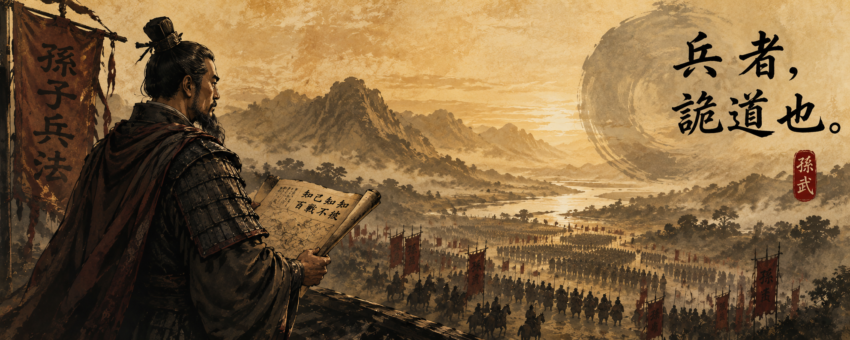
Book Title: The Art of War
Author: Sun Tzu (Sun Wu, c. 544-496 BC). Chinese general, strategist, and philosopher. Served King Helü of Wu. Wrote during the Eastern Zhou period.
Published: c. 5th century BC. Compiled in the Warring States period.
Category: Military Strategy, Philosophy, Leadership, Business Strategy
Table of Contents
- 1. Book Basics
- 2. The Big Idea
- 3. The Core Argument
- 4. What I Liked
- 5. What I Questioned
- 6. One Image That Stuck
- 7. Key Insights
- 8. Action Steps
- 9. One Line to Remember
- 10. Who This Book Is For
- 11. Final Verdict
- 12. Deep Dive: The Five Factors and Seven Questions
- 13. Deep Dive: Formlessness and the Nine Situations
- 14. Deep Dive: Spies and Information
- 15. Deep Dive: Comparison to Clausewitz
- 16. Final Reflection: War as the Last Resort
1. Book Basics
Why I picked it up:
The Art of War is the oldest military treatise in the world. It is not about battle. It is about winning before battle starts.
Sun Tzu was a general. He served King Helü of Wu. He took a weak state and beat the strong state of Chu. Legend says he trained the king’s concubines. He executed two for disobedience. Then the rest obeyed. The story shows his view. Discipline matters more than numbers.
The book addresses one problem. How do you win? War costs lives and money. It drains the state. It must be quick. It must be cheap. It must be done with the mind, not just the sword.
The central thesis is this: All warfare is based on deception. Win first. Fight second. If you must fight, you already failed. The best victory is the one where no battle occurs.
This book is different from Western war books. Clausewitz writes of friction and blood. Sun Tzu writes of water and formlessness. He uses Taoist ideas. He says yield to win. He says be empty, then full. He writes in short lines. Each line is a tool.
Expect 13 chapters. Each chapter is brief. The whole book is about 6000 Chinese characters. You can read it in one hour. You will study it for life. The style is direct. No stories. No names. Only principles.
2. The Big Idea
The core premise is that war is the way of deception. You win by creating illusions. Appear weak when strong. Appear strong when weak. Appear far when near. Appear near when far. The enemy moves to shadows. You hit where he is not.
The problem is cost. War drains the state. Prolonged war ruins armies. It angers people. It empties treasuries. A wise general avoids long war. He wins fast. He wins cheap. He wins without fighting if possible.
The book offers a reframe. Do not seek battle. Seek advantage. Shape the enemy. Do not be shaped. Force the enemy to react to you. Do not react to him. The goal is not glory. The goal is survival of the state.
Conventional wisdom says the big army wins. Sun Tzu says the prepared army wins. He says five factors matter. Moral law. Heaven. Earth. Command. Method. Measure these before war. If you score higher, you win. If lower, you lose. Do not fight then.
The fundamental insight is that formlessness wins. Have no fixed shape. Water flows to low places. It avoids high places. An army should avoid strength. It should strike weakness. Be like water. Take the shape of the enemy. Then vanish.
What changes:
Your view of conflict shifts. You stop wanting to fight. You want to win. Fighting is a last resort. You start to see terrain, timing, and morale as weapons.
This reframe affects choices. You ask five questions first. Do people follow the ruler? Does heaven favor the time? Does earth favor the ground? Is the commander wise? Is the army disciplined? If no, do not move.
This matters beyond war. Business uses it. Sports use it. Law uses it. Any contest uses it. The book is about strategy, not just swords.
3. The Core Argument
Argument 1: War is vital to the state. It is the ground of death and life. The way of survival or ruin. You must study it. You cannot skip it.
Argument 2: Measure before you fight. Five factors decide. Moral law means people and ruler are one. Heaven means night, day, cold, heat. Earth means high, low, far, near. Command means wisdom, trust, courage. Method means order, supply, cost. Count these. The side with more wins.
Argument 3: All warfare is deception. Pretend disorder. Then strike. Pretend fear. Then attack. Pretend weakness. Then be strong. Anger the enemy general. Make him rash. Appear unready. Then surprise him.
Argument 4: Win first, then fight. The victorious army wins before battle. The defeated army fights hoping to win. Plan in the temple. Count. If you have more, you win. If equal, fight if skilled. If less, run.
Argument 5: The best win is without battle. To win one hundred victories is not the best. To subdue the enemy without fighting is best. Attack plans. Next, attack alliances. Next, attack the army. Worst is to attack cities.
Argument 6: Know yourself and know the enemy. If you know both, you win every battle. If you know yourself but not the enemy, you win one and lose one. If you know neither, you lose every battle.
Argument 7: Speed is the essence of war. Move like wind. Strike like lightning. Do not let the enemy prepare. Prolonged war blunts weapons. It dulls troops. No state gains from long war.
Argument 8: Use the enemy to feed you. Bring supplies for your army. Forage from the enemy. One cart of enemy food equals twenty of your own. Make soldiers angry at the enemy, not at hardship.
Argument 9: Adapt like water. Water has no constant shape. An army has no constant form. Change with the enemy. Do not repeat tactics that won before. The enemy expects them.
Argument 10: Command controls all. The general is the nation’s support. If strong, the nation is strong. If weak, the nation is weak. The ruler must not interfere. When the army moves, the ruler’s command stops.
4. What I Liked
Strength 1: The book is short. It says much in few words. Each line is a tool. You can memorize it. You can apply it fast.
Strength 2: It puts war in context. War is not glory. War is cost. It hurts the state. It hurts people. The goal is to end it fast. That view is humane.
Strength 3: It values intelligence. Spies are the last chapter. They are most important. To know the enemy, you need men inside. Information beats force.
Strength 4: It uses nature. Water, wind, fire, ground. The book ties war to the world. It does not make war separate. It says terrain is a weapon.
Strength 5: It works outside war. CEOs read it. Coaches read it. Lawyers read it. The ideas scale. Know the ground. Know the enemy. Strike weakness.
Strength 6: It respects limits. Do not siege if you can avoid it. Do not fight uphill. Do not cross rivers in front of enemies. The book lists what not to do. That saves lives.
5. What I Questioned
Limitation 1: The book assumes a ruler and a general. It speaks to kings. It assumes command is clear. Modern war is messy. Politics enters. The book says little on that.
Limitation 2: Deception has a cost. If you lie always, your men stop trusting you. If you burn bridges, you cannot cross back. The book pushes deception hard. It says less about trust.
Limitation 3: The book is abstract. No battles are named. No examples given. You must fill in the blanks. That makes it wide. It also makes it vague. Beginners can misuse it.
Limitation 4: It says little on ethics. The goal is to win. It says do not kill prisoners for anger. It says treat captives well. But the core is victory. The cost to others is secondary.
Limitation 5: It favors offense. The book says attack. It says little on defense. It says hold when weak. But the spirit is strike. Defense can win too. The book underplays it.
Limitation 6: Translation shifts meaning. The Chinese is terse. Words have many meanings. Shi can mean power, position, or momentum. English picks one. You lose nuance. Read more than one version.
6. One Image That Stuck
Water
Sun Tzu says the army should be like water. Water avoids high ground. It flows to low ground. Water shapes itself to the land. It is soft. Yet it can carve rock. It can drown cities.
He uses this image in Chapter 6. The point is formlessness. Do not stay in one form. The enemy cannot plan against water. If he is solid, be empty. If he is empty, be solid. Appear where he does not expect.
The image is powerful because everyone knows water. It yields. It still wins. It does not break. It flows around. It takes the path of least resistance. Then it gathers. Then it strikes.
This image reframes the book’s insight. Do not meet strength with strength. That is grinding. That is long war. Meet strength with void. Meet void with strength. Move to gaps. Gaps are ground the enemy did not guard. Water finds gaps. So should you.
The image teaches strategy without blood. You can see it. You can test it. Pour water on dirt. Watch it move. That is how an army should move.
7. Key Insights
- The expert wins without battle. He shapes the enemy first. He cuts supply. He breaks alliances. He makes the enemy surrender. Fighting is failure of earlier steps.
- Five things decide victory. Moral law, heaven, earth, command, method. Score yourself. Score the enemy. If you are down, do not fight. Build first.
- Speed saves money. Long war costs the state. Troops grow tired. Supplies run out. Prices rise at home. Strike fast. Return fast.
- A cornered enemy fights hard. Do not press a desperate foe. Leave an outlet. He will run. Then you can hit him. If no escape, he will fight to death. You lose men.
- Use local guides. Do not move an army without them. You will get lost. You will miss water. You will hit swamps. Ground kills more than swords.
- Rewards must be clear. Punishments must be sure. If orders are unclear, the fault is the general. Train first. Kill second. After training, disobedience is death.
- Forage from the enemy. One cart from the enemy is worth twenty from home. Anger your men at the enemy. They will eat his food with zeal.
- There are five kinds of spies. Local spies. Inward spies. Converted spies. Doomed spies. Living spies. Use all. No bond is closer than spies. No reward is too high.
- No constant form in war. What won yesterday loses today. The enemy learns. You must change. Be formless. Be dark. Be like night.
- The general must be calm. He cannot be angered. He cannot be shamed. He cannot be confused. His calm is the army’s base. If he shakes, all shakes.
8. Action Steps
Start: Score the five factors. Use when: Before any conflict or project. The Practice:
- Write Moral Law. Do people support you? Score 1 to 5.
- Write Heaven. Is timing good? Score 1 to 5.
- Write Earth. Is ground in your favor? Score 1 to 5.
- Write Command. Is your leader wise and trusted? Score 1 to 5.
- Write Method. Is your team trained and supplied? Score 1 to 5.
- Score the enemy the same.
- If you are lower, do not engage. Build first. Why it works: Sun Tzu says measure first. This stops ego fights. You see reality.
Stop: Fighting on their ground. Use when: You feel pushed to react. The Practice:
- Name where the enemy is strong.
- List where he is weak.
- Refuse battle on his ground.
- Pull him to your ground. Use bait.
- Strike when he moves. Why it works: Strength against strength is waste. The book says avoid what is strong. Hit what is empty.
Try for 13 Days: Read one chapter a day. Use when: You start a competition or project. The Practice: Day 1: Read Laying Plans. Score yourself. Day 2: Read Waging War. Check costs. Day 3: Read Attack by Stratagem. Plan to win without fight. Day 4: Read Tactical Dispositions. Secure first. Day 5: Read Energy. Use force cycles. Day 6: Read Weak Points and Strong. Be formless. Day 7: Read Maneuvering. Avoid direct routes. Day 8: Read Variation in Tactics. Adapt. Day 9: Read The Army on the March. Read ground. Day 10: Read Terrain. Know six types. Day 11: Read The Nine Situations. Know where you stand. Day 12: Read Attack by Fire. Use tools. Day 13: Read Use of Spies. Build information. Why it works: The book is short. Daily study builds reflex. What you’ll notice by day 13: You see ground and timing first. You seek advantage, not battle.
9. One Line to Remember
“Supreme excellence is to subdue the enemy without fighting.”
Or: “Know the enemy and know yourself. In a hundred battles you will never be in peril.”
Or: “Be extremely subtle, even to the point of formlessness. Be extremely mysterious, even to the point of soundlessness.”
10. Who This Book Is For
Good for: Leaders, managers, and competitors. People who face conflict. Military officers. Business owners. Coaches. Negotiators. Anyone who must plan.
Even better for: People who hate waste. Those who prefer prep to reaction. Readers who like principle over story. Those who want tools, not tales.
Skip or read critically if: You want history or battles. You want ethics first. You need step by step tactics. The book is abstract. You must apply it yourself.
11. Final Verdict
The Art of War is a manual for winning. Its greatest strength is clarity. It says war is cost. It says win before you fight. It says know both sides. Those rules hold.
Its greatest limitation is coldness. It treats men as pieces. It treats deception as total. It says little on justice. It says much on victory. Read it with a conscience.
The book accomplishes this: It gives a lens. You see conflict as terrain, timing, and morale. You see options besides attack. You see the value of information.
It does not accomplish this: It does not teach tactics. It does not name battles. It does not discuss peace after. It is a start, not a finish.
You will benefit most if you use it to avoid fights. You will lose if you use it to start them.
The lasting impact is this: After Sun Tzu, strategy meant more than force. It meant mind. It meant water. The book delivers on its promise. It teaches how to win. It also teaches that not fighting is best.
12. Deep Dive: The Five Factors and Seven Questions
The Five Factors Explained
1. Moral Law The people agree with the ruler. They will follow him. They will die with him. Without this, no victory lasts. You cannot buy it. You earn it by benevolence and justice.
2. Heaven Night and day. Cold and heat. Times and seasons. You do not attack in winter without coats. You do not march in flood. Timing is a weapon. Wait for it.
3. Earth Distance. High and low. Near and far. Narrow and wide. Safe and danger. Ground shapes battle. High ground is strength. Sun at your back is strength. Know the map.
4. Command Wisdom. Sincerity. Benevolence. Courage. Strictness. The general must have all five. Wisdom sees. Sincerity binds. Benevolence earns love. Courage holds. Strictness orders. Miss one, and the army breaks.
5. Method and Discipline Organization. Chain of command. Supply lines. Control of cost. A disordered army loses before it fights. A hungry army loses before it fights.
The Seven Questions
Sun Tzu says ask these in the temple before war:
- Which ruler has moral law?
- Which general has ability?
- Who has heaven and earth?
- Whose laws are carried out?
- Whose army is stronger?
- Whose officers are trained?
- Whose rewards and punishments are clear?
Answer these. You know the winner. If you do not know, do not move. This is audit before action. Business can use it. Pick a market. Score yourself and the rival. If down, build or leave. Do not fight.
13. Deep Dive: Formlessness and the Nine Situations
Formlessness
Chapter 6 says the best army has no form. The enemy cannot scout it. If you are formless, you can be all forms. Show empty when full. Show full when empty. Make the enemy prepare everywhere. Then he is weak everywhere.
Tactics: Appear at places he must rush to defend. He will divide. Then you hit one point with all force. That is concentration vs dispersion. You win by being one against many.
The Nine Situations
Chapter 11 lists nine grounds. Each demands a different act.
1. Dispersive ground. Fight in your own land. Men can run home. They will. Do not fight here. 2. Facile ground. Into enemy land but not deep. Do not stop. Keep moving. 3. Contentious ground. Both sides want it. Strike first. 4. Open ground. Easy movement. Do not block. Keep lines open. 5. Ground of intersecting highways. Join with allies. Do not let enemy cut you off. 6. Serious ground. Deep in enemy land. Men cannot run. They will fight hard. Use that. 7. Difficult ground. Mountains, forests, swamps. Press on. Do not camp. 8. Hemmed in ground. Narrow ways. Use surprise. 9. Desperate ground. No escape. Fight now. Men will be brave.
The point: Ground changes rules. You cannot use one plan. You must read the ground. Then choose the act. A good general reads ground like a book.
14. Deep Dive: Spies and Information
Why Spies Are Last
The book ends with spies. That is on purpose. All the plans fail without knowledge. You must know the enemy’s plans. You must know his food. You must know his allies. You must know his generals.
Five kinds of spies:
Local spies. Hire locals. They know the land. They know the people. Inward spies. Use enemy officials. Bribe them. Converted spies. Take enemy spies. Turn them. Feed them false info. Doomed spies. Send your men with false info. Let enemy catch them. Enemy acts on lies. Living spies. Come back with reports. They are the core.
Sun Tzu says no relation is closer than spies. No reward too high. If you are stingy with spies, you will lose men and war. One spy can save ten thousand lives.
Modern Use
Information wins. Business calls it market research. Sports calls it film study. War calls it intel. The method is old. Get men inside. Treat them well. Check their word. Act on it. Without it, you are blind. A blind army fights shadows.
15. Deep Dive: Comparison to Clausewitz
Key Differences
Sun Tzu: War is deception. Goal is win without fighting. Speed matters. Moral law matters. The general decides. The ruler stays out.
Clausewitz: War is friction. Goal is to compel enemy to do your will. Battle is core. Moral forces matter but fog rules. The ruler owns war. The general obeys.
Sun Tzu: Water analogy. Be formless. Avoid strength. Clausewitz: Wrestling analogy. Two forces grip. Center of gravity. Strike it.
Sun Tzu: Short war best. Cost ruins state. Clausewitz: War can be long. Politics extends it. Absolute war vs real war.
Sun Tzu: Few stories. All principle. Clausewitz: Many cases. History drives theory.
Which to Use When
Use Sun Tzu when you can choose battle. Use him in business, sport, and startups. You can pick time and place. You can avoid fight.
Use Clausewitz when battle is forced. Use him in total war. Use him when politics rules all. You cannot avoid fight. You must manage it.
Sun Tzu gives the plan. Clausewitz gives the warning. Read both. Sun Tzu tells how to win. Clausewitz tells why winning is hard.
16. Final Reflection: War as the Last Resort
Sun Tzu starts with a warning. War is vital to the state. It is the ground of death and life. Study it. Do not love it.
The book repeats this idea. Prolonged war hurts. Sieges waste men. Battle is worst. The best move is to break plans. The next is to break alliances. The next is to break the army. The last is to attack cities.
The final line of Chapter 3 says it plain. To win one hundred victories is not the best. To subdue without fighting is best. That is the overarching theme.
The book’s contribution is control. It gives you checks. Measure first. Do not move from anger. Do not move from pride. Move from count. If count is bad, train. If count is good, move fast.
The balance is this. The book controls method. It does not control fate. It does not control politics. It says the ruler must not interfere with the general. History shows rulers do. The book is ideal. Real life is messy.
The deeper lesson is about the mind. War happens in the head first. Shape the enemy’s head. Shape your own. Fear, anger, and greed lose battles before swords clash. Calm, void, and timing win.
How does this change understanding going forward? You stop seeing conflict as force. You see it as information and position. You ask where the gap is. You ask what the enemy expects. You do the other thing.
A memorable closing thought: Sun Tzu wrote for kings. Yet his best line is restraint. He teaches war to end war. The work is not to fight. The work is to make fighting useless. That is the art.