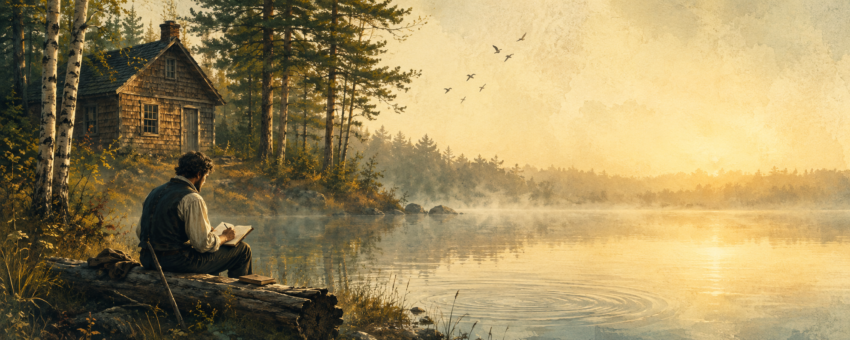
Book Title: Walden
Author: Henry David Thoreau (1817-1862). American essayist, poet, naturalist, and philosopher. Transcendentalist. Lived two years at Walden Pond. Surveyor, pencil maker, abolitionist.
Published: 1854. Written after his time at Walden Pond from 1845 to 1847.
Category: Memoir, Philosophy, Nature Writing, Transcendentalism, Social Criticism
Table of Contents
- 1. Book Basics
- 2. The Big Idea
- 3. The Core Argument
- 4. What I Liked
- 5. What I Questioned
- 6. One Image That Stuck
- 7. Key Insights
- 8. Action Steps
- 9. One Line to Remember
- 10. Who This Book Is For
- 11. Final Verdict
- 12. Deep Dive: Economy and the Cost of Living
- 13. Deep Dive: Nature as Teacher
- 14. Deep Dive: Solitude and Society
- 15. Deep Dive: Comparison to Emerson
- 16. Final Reflection: Deliberate Living
1. Book Basics
Why I picked it up:
Walden is an experiment. Thoreau went to the woods to live deliberately. He wanted to front only the essential facts of life. He wanted to see what life could teach if he did not get it secondhand.
Thoreau had authority. He was Harvard educated. He worked as a teacher, a surveyor, and a pencil maker. He refused to pay a tax that supported slavery. He spent a night in jail. Emerson was his mentor. But he left Concord to test ideas himself.
The book addresses the problem of waste. Men labor under mistakes. They buy what they do not need. They work jobs they hate. They live lives of quiet desperation. They rush. They miss. They die without living.
The central thesis is this: Simplify. Reduce life to its lowest terms. Live near nature. Work with your hands. Read. Think. Watch. You will find that most things called necessary are not. You will find that you need little. You will find that you are rich.
This book is different from advice. It is not a how to. It is a record. Thoreau tells what he did. He tells what it cost. He tells what he saw. He tells what he thought. You must decide what to take.
Expect 18 chapters. First person. Long sentences. Sharp detail. Satire. Sermon. Science. Poetry. It moves by season. Summer to spring. It begins with economy. It ends with spring. The structure is a year. The meaning is a life.
2. The Big Idea
The core premise is that most men live lives of quiet desperation. They inherit farms. They inherit trades. They inherit debts. They inherit opinions. They never ask why. They work. They buy. They die.
The problem is unconscious living. People wake. They dress. They work. They sleep. They never wake to life. They live as ants. They live as machines. They call it necessity. It is habit.
The book offers a reframe. Go to the woods. Or go to your room. Strip away. Find what you must have. Food. Shelter. Clothing. Fuel. Find what they cost in labor. Then ask. What else do I want? Do I want it enough to pay with life?
Conventional wisdom says more is better. Bigger house. More land. More clothes. More news. Thoreau says less is more. One room is enough. One suit is enough. One meal a day may be enough. Time is the real wealth.
The fundamental insight is that you are rich by wants, not by goods. A man is rich in proportion to the things he can do without. The value of a thing is the life you trade for it. A coat costs days of your life. Is it worth it?
What changes:
Your view of economy shifts. Economy is not money. Economy is life. Every purchase costs life. Every job costs life. You start to ask the price in days. You start to say no.
This reframe affects choices. You stop buying. You stop rushing. You stop reading the news. You start walking. You start watching. You start thinking. You find you have time.
This matters beyond the pond. You live in a city. You have a job. You can still simplify. You can still wake. The book is not about woods. It is about attention. The woods helped Thoreau pay attention. Find your pond.
3. The Core Argument
Argument 1: Most of life is needless. Men labor for luxuries. Luxuries become needs. Then they labor for more. This is slavery. The savage is richer. He has few wants. He meets them fast. Then he has leisure. Chapter 1: Economy.
Argument 2: Simplify your affairs. Keep your accounts. Know what you spend. Know what you earn. Most men do not. They are lost. Thoreau built his house for $28.12. He grew food. He spent little. He worked six weeks a year. The rest was free. Chapter 1.
Argument 3: Read well, not much. The wisest men read least. They read the classics. They read with attention. Newspapers are gossip. One paper a week is enough. Books must be read as deliberately as they were written. Chapter 3: Reading.
Argument 4: Sounds teach. He listened to church bells. He listened to cows. He listened to owls. He listened to the ice. Each sound had meaning. Noise is not sound. Silence is full. Chapter 4: Sounds.
Argument 5: Solitude is society. He had no neighbor for miles. He was not lonely. He was near nature. He was near himself. One is company. Two is crowd. Three is noise. Chapter 5: Solitude.
Argument 6: Visitors show the world. Farmers came. Runaway slave came. Canadian woodchopper came. Philosopher came. He learned from each. He gave no chairs. They sat on the floor. They talked. Chapter 6: Visitors.
Argument 7: The pond is the world. Walden Pond is deep. It is pure. It is a mirror. It freezes. It thaws. It holds fish. It holds thought. To know one thing well is to know all things. Chapter 9: The Ponds.
Argument 8: Spring is resurrection. Ice breaks. Grass grows. Seeds wake. The dead live. This is the law. After winter, spring. After despair, hope. The book ends here. Chapter 17: Spring.
Argument 9: Explore yourself. Be a Columbus to your own mind. Sail all seas. The world is in you. Travel is not needed. Newspapers bring the world. But you do not know yourself. Chapter 18: Conclusion.
Argument 10: Live deliberately. Go to the woods. Or stay home. But live. Front the facts. See if you can learn what life has to teach. If not, die and know you did not live. Chapter 2: Where I Lived.
4. What I Liked
Strength 1: The detail is alive. He measures the pond. 102 feet deep. He weighs the ice. He counts the bricks. He lists costs to the penny. The book is concrete. You can build from it.
Strength 2: The humor cuts. He mocks philanthropy. He mocks the railroad. He mocks fashion. He says, the mass of men lead lives of quiet desperation. The line stings. It wakes.
Strength 3: The sentences stand. “I went to the woods because I wished to live deliberately.” “Simplicity, simplicity, simplicity.” “If a man does not keep pace with his companions, perhaps it is because he hears a different drummer.” You remember them.
Strength 4: He did it. He lived two years, two months, two days at Walden. He was not theory. He built the house. He grew beans. He hoed. He walked. He sat. The book earns its right.
Strength 5: It honors nature. The loon. The ant war. The ice. The sand foliage. He watches close. He writes clear. He makes you see. You walk out and look again.
Strength 6: It calls you out. Are you awake? Are you alive? Have you lived? The book asks. It does not let you hide. That is rare.
5. What I Questioned
Limitation 1: He was not alone. Walden was a mile from town. He walked to Concord. He had dinner with Emerson. He had visitors daily. His mother did his laundry. The myth of hermit is wrong.
Limitation 2: He had money. He owned the land through Emerson. He had Harvard education. He had skills. He could choose poverty. Most cannot. The experiment needs a base.
Limitation 3: He judges others. Farmers are stupid. Irish are dirty. Philanthropists are false. He mocks. He sets himself apart. The tone is cold. The reader feels judged.
Limitation 4: The book is long. 18 chapters. Some drag. Bean field. Former inhabitants. He repeats. He preaches. You must wade. The pond has weeds.
Limitation 5: He left. Two years, then back to town. Why? He said he had other lives to live. That undercuts the claim. If Walden was true, stay. He did not. The experiment ended.
Limitation 6: It can breed arrogance. Readers go to woods. They come back. They scorn others. They quote Thoreau. They miss his point. He said, do not follow me. Find your own path.
6. One Image That Stuck
The Ice on Walden
Thoreau watches the pond freeze. He measures the ice. He cuts it. He sees men harvest it. They pack it in sawdust. They ship it to India. Walden water cools the drink of a Brahmin.
He uses this in Chapter 16: The Pond in Winter. The image is strong. A local pond goes global. The pure water of Concord serves Calcutta. The world is one. Trade connects. Yet the pond stays.
He lies on the ice. He studies it. He sees bubbles. He sees colors. He sees it boom at night. It is alive. Then men saw it. They take it. The pond gives. It does not lose.
This image reframes the book’s insight. You can be local. You can be global. You can be still. You can serve. Do not move to India. Be Walden. Be deep. Be pure. The world will come.
The image teaches without law. The pond does not try. It is. It freezes. It melts. It gives ice. It gives fish. It gives thought. Be like that. Do your work. Let it go.
7. Key Insights
- The mass of men lead lives of quiet desperation. They inherit debt. They work without end. They die without living. Wake. Chapter 1: Economy.
- A man is rich by what he can do without. Wealth is not goods. Wealth is wants. Reduce wants. You are rich. Chapter 2: Where I Lived.
- Simplify, simplify, simplify. Do not count three. Say it three times. Life is frittered by detail. Cut. Chapter 2.
- If you have built castles in the air, your work need not be lost. That is where they should be. Now put foundations under them. Dream. Then work. Chapter 18: Conclusion.
- The cost of a thing is the amount of life you exchange for it. A coat costs days. A house costs years. Ask the price in life. Then buy. Or not. Chapter 1.
- Read the best books first. The rest you can leave unread. Classics are the noblest thoughts. Newspapers are sand. Choose. Chapter 3: Reading.
- I never found the companion as companionable as solitude. One is company. Two is a crowd. Learn to be alone. Then you can be with others. Chapter 5: Solitude.
- Heaven is under our feet as well as over our heads. You do not need to go far. The local is holy. The near is deep. Walden is enough. Chapter 8: The Village.
- Things do not change. We change. The pond is the same. I see it new. The change is in me. That is growth. Chapter 9: The Ponds.
- Only that day dawns to which we are awake. There is more day to dawn. The sun is but a morning star. Wake. Then you live. Chapter 18: Conclusion.
8. Action Steps
Start: Audit one expense. Use when: You feel poor or rushed. The Practice:
- Pick one cost. Coffee. Phone. Car.
- Find yearly total.
- Divide by your hourly wage.
- See days of life it costs.
- Ask, is it worth it? Why it works: Thoreau priced his house to the nail. You see the trade. You choose. That is freedom.
Stop: Reading the news daily. Use when: You feel anxious and full. The Practice:
- Skip news for one week.
- Read one book instead.
- Walk 30 minutes instead.
- Note your mind. Clearer?
- Keep the rule: one paper a week. Why it works: Thoreau said we are fed carrion. News is gossip. It steals attention. Silence feeds.
Try for 4 Seasons: One month of deliberate living. Use when: You feel lost in routine. The Practice: Week 1: Track time. Where does it go? Week 2: Cut one want. One subscription. One habit. Week 3: Add one essential. Walk. Read. Cook. Week 4: Sit alone one hour. No phone. No book. Watch. Why it works: Walden was two years. You try one month. You taste it. You see what is extra. What you’ll notice by week 4: You have time. You hear sounds. You feel rich with less.
9. One Line to Remember
“I went to the woods because I wished to live deliberately.”
Or: “The mass of men lead lives of quiet desperation.”
Or: “Simplicity, simplicity, simplicity.”
10. Who This Book Is For
Good for: People tired of noise. People in debt. People who hate their job. Readers who love nature. Anyone who asks, is this all?
Even better for: Those who can test it. Students on break. Retired. Writers. Those between jobs. Anyone who can step back for a time.
Skip or read critically if: You need a plan. You want steps. You need community. You cannot stand judgment. Read it as record, not rule, if that is you.
11. Final Verdict
Walden is an experiment in living. Its greatest strength is clarity. It shows the cost. It shows the trade. It shows another way. You can live on little. You can have much time.
Its greatest limitation is privilege. Thoreau could leave. He had a base. He had friends. He had health. Many cannot. The book ignores that. It preaches to those who can choose.
The book accomplishes this: It wakes you. It asks, are you alive? It gives you tools. Measure. Simplify. Watch. Walk. It gives you permission to stop.
It does not accomplish this: It does not give a system. It does not tell you to go to the woods. It says, live deliberately. You must define that. He will not.
You will benefit most if you test one thing. You will lose if you copy all.
The lasting impact is this: After Thoreau, you cannot unsee the trade. Every purchase is days. Every job is life. Every hour is a choice. The book delivers on its promise. It shows essential facts. It asks if you learned them. The answer is yours.
12. Deep Dive: Economy and the Cost of Living
The House
Thoreau builds a house. 10 feet by 15 feet. One room. He lists costs. Boards $8.03. Nails $3.90. Bricks $4.00. Total $28.12. He values his labor at $1 a day. He worked six weeks. Total cost under $40.
He compares to others. Farmers pay $1000 for houses. They mortgage. They work 30 years. They die. He lives in his house two years. He sells it for profit. The point is not cheap house. The point is freedom.
The Food
He grows beans. 2.5 acres. He hoes seven miles. He sells $23.44. He eats $8.74. Profit $14.72. He works six weeks. He reads the rest. He says labor is best when it leaves you leisure.
He eats little. One meal a day sometimes. Bread. Potato. No meat. No coffee. No tea. He says the savage is stronger. He eats simple. He works less.
The Clothes
One suit. Strong. Plain. He says beware of enterprises that require new clothes. Fashion is a tax. It costs life. Wear old. Wear what works. The goal is warmth and decency. Not style.
Modern Use
You need not build a hut. Audit your house. How many rooms empty? How many hours to pay? Audit your food. How much waste? Audit your clothes. How many unworn? The principle holds. The details change.
13. Deep Dive: Nature as Teacher
The Pond
Walden is the center. He maps it. He sounds it. 102 feet deep. He finds it pure. He finds it has no inlet. It is spring fed. It is a mirror. It reflects sky. It reflects self. To know it is to know laws. To know laws is to know self.
The Animals
The loon laughs. It dives. It surfaces far off. It mocks him. It teaches skill. The ants war. Red vs black. He sees Troy in them. Nature has war. Nature has peace. The owl hoots. The cock crows. Each sound is a word. Learn the language.
The Seasons
The book follows a year. Summer. He builds. Fall. He harvests. Winter. He watches ice. Spring. He sees rebirth. The cycle is the lesson. Life ends. Life begins. You are part. Do not fight it. Notice it.
Why It Matters
Men live in rooms. They read books. They miss the sun. Thoreau says go out. Watch. The world teaches. A leaf teaches. A pond teaches. You do not need a guru. You need eyes. Open them.
14. Deep Dive: Solitude and Society
Alone
Thoreau was not lonely. He says he had company. Nature. Himself. God. One is enough. Two is crowd. The mind needs space. Society brings noise. Noise brings thoughtless. Be alone. Hear.
With Others
He had visitors. Farmers. Slaves. Poet. Philosopher. He talked. He liked it. But he chose. He did not live in the village. He went to it. He left it. Society on terms. That is the rule.
The Village
He walks to Concord. He hears news. He hears gossip. He calls it. He leaves. The village is not evil. It is loud. It is small. It distracts. Use it. Do not live in it.
The Rule
Be alone when you need thought. Be with others when you need talk. Choose. Do not drift. Most men do not choose. They are never alone. They are never with. They are in a crowd, lonely.
15. Deep Dive: Comparison to Emerson
Emerson
Thoreau’s mentor. Wrote Nature . Said build your own world. Be self reliant. Trust the inner voice. The world is a symbol. God is in you.
Thoreau
Lived it. Emerson wrote. Thoreau built. Emerson said, go. Thoreau went. Emerson kept house. Thoreau left house.
Key Differences
Emerson: The world is idea. Nature is spirit. Thoreau: The world is fact. Nature is dirt. Touch it.
Emerson: Self reliance is mind. Thoreau: Self reliance is hand. Hoe beans.
Emerson: The poet. Thoreau: The surveyor. He measured.
Which to Read
Read Emerson for vision. Read Thoreau for test. Emerson tells you to wake. Thoreau shows you how. You need both. Dream and work.
16. Final Reflection: Deliberate Living
Thoreau ends with spring. The ice breaks. The sand flows. The earth lives. The dead live. That is the law. You are part.
The overarching theme is wake. Most men sleep. They walk. They work. They sleep. They never wake. To wake is to see. To see is to choose. To choose is to live.
The book’s contribution is the question. Did you live? You will die. All do. Did you live? If not, why? What stopped you? Debt? Fear? Opinion? Name it. Cut it.
The balance is this. He did not stay. He left. He wrote. He lectured. He surveyed. He lived in town. Walden was two years. Not a life. It was a test. He passed. He moved on. You must too.
The deeper lesson is about time. Time is life. Money is time. Job is time. House is time. Spend it well. You do not get it back.
A memorable closing thought: The last paragraph says it. Only that day dawns to which we are awake. There is more day to dawn. The sun is but a morning star. Wake. The day begins.