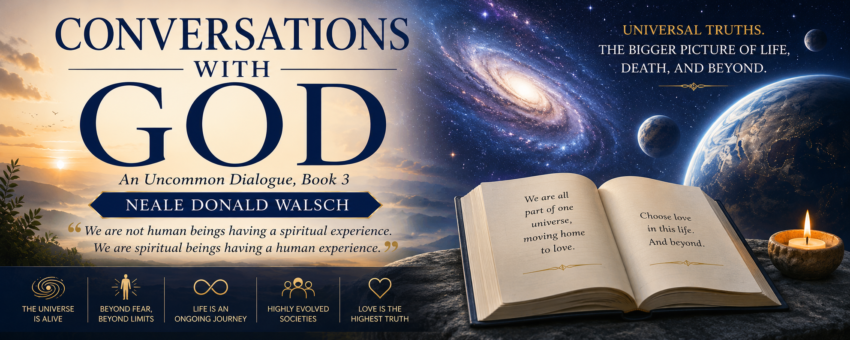
Book Title: Conversations with God: An Uncommon Dialogue, Book 3
Author: Neale Donald Walsch. American author who presents this as the final volume of his written dialogue with God, closing out the original trilogy.
Published: 1998
Category: Spirituality. Religion and Philosophy. Cosmology.
Table of Contents
- 1. Book Basics
- 2. The Big Idea
- 3. The Core Argument
- 4. What I Liked
- 5. What I Questioned
- 6. One Image That Stuck
- 7. Key Insights
- 8. Action Steps
- 9. One Line to Remember
- 10. Who This Book Is For
- 11. Final Verdict
- 12. Deep Dive: Highly Evolved Beings as a Model for Humanity
- 13. Deep Dive: Reincarnation and the Critique of Fear Based Religion
1. Book Basics
Why I picked it up:
Conversations with God Book 3 closes out the original trilogy, moving from the personal focus of Book 1 and the societal focus of Book 2 into what the book calls universal truths.
Neale Donald Walsch describes the three books as following a clear progression. Book 1 covers individual truths. Book 2 covers global truths. Book 3 covers universal truths, dealing with other realms, other dimensions, and the larger structure the author says connects them all.
The book addresses the largest questions a person can ask. What is the nature of the universe, is there life beyond Earth, what happens after death, and what would a truly advanced civilization look like.
Its central promise is a description of what the book calls Highly Evolved Beings and Highly Evolved Societies, offered as a model for how humanity might grow beyond fear, conflict, and scarcity.
Readers should expect the same question and answer dialogue format as the earlier books, but applied to cosmic and metaphysical topics rather than personal or societal ones.
2. The Big Idea
The core premise is that humanity is one of many forms of life in the universe, and that more advanced civilizations offer a working model for what human society could become.
The book identifies a problem that carries over from Book 2. Human society still organizes itself around fear, judgment, and separation, and this keeps humanity from reaching what the book calls a highly evolved state.
The paradigm shift is this: the book describes societies that have moved beyond violence, ownership, and fear entirely, not as fantasy, but as a realistic future stage of development that humanity can reach.
Conventional religious teaching often treats Earth and humanity as the central focus of creation. The book argues instead that Earth is a young, relatively undeveloped society within a much larger universe of conscious life.
The fundamental insight offered is that spiritual evolution, not technology alone, is what separates a highly evolved civilization from a less evolved one.
What changes:
Readers start to view human problems, such as war, scarcity, and fear of death, against the backdrop of a much larger and longer arc of development.
This reframe affects how readers think about mortality and meaning, since the book presents death as one step in an ongoing, chosen cycle rather than a final end.
This matters because it extends the book’s core theme, choosing love over fear, from the personal and societal level all the way to a cosmic scale.
3. The Core Argument
- Humanity is not alone in the universe: The book states directly that life exists elsewhere in the universe, and that this should not be treated as a fringe idea.
- Highly Evolved Beings do not experience anger or attack: The book describes advanced beings as incapable of feeling attacked, because they do not attach their identity or survival to possessions, status, or even their own body.
- Reincarnation is presented as real: The book argues that souls return across multiple lifetimes as part of an ongoing process of the soul creating and knowing itself, rather than living only one life followed by permanent judgment.
- Organized religion added fear based doctrine over time: The book traces the historical development of concepts like purgatory and indulgences, arguing the early church added these ideas partly to maintain control and membership.
- The universe operates on a cycle the book calls the Cosmic Wheel: Souls are described as moving through a continuous cycle between oneness and separation, then back to oneness again.
- Death is a transition, not an ending: Consistent with earlier books in the trilogy, this volume describes death as a choice point within an ongoing existence, not a final judgment.
- Highly Evolved Societies do not use money or ownership the way humans do: The book describes advanced societies as organizing life without the scarcity based systems common on Earth.
- Free will extends across lifetimes and realms: The book argues that souls choose their experiences, including where and how they return, rather than having this decided for them.
4. What I Liked
- Ambitious closing scope: The book takes the trilogy’s core theme, fear versus love, and extends it to its largest possible scale.
- Clear historical argument on religious doctrine: The discussion of how concepts like purgatory and indulgences developed offers a specific, traceable argument rather than only abstract claims.
- Consistent internal logic: The book connects back clearly to themes from Book 1 and Book 2, giving the trilogy a unified structure.
- Addresses mortality directly: The extended discussion of reincarnation and death engages with one of the most difficult questions readers bring to spiritual writing.
- Vivid concept of Highly Evolved Beings: This recurring idea gives readers a concrete picture to hold onto amid otherwise abstract cosmic discussion.
- Maintains the trilogy’s accessible tone: Despite the larger scope, the dialogue format keeps the material readable rather than academic.
5. What I Questioned
- The most speculative volume of the trilogy: Claims about extraterrestrial life, other dimensions, and Highly Evolved Societies are the least verifiable claims in the entire series.
- Same unresolved authorship claim as Books 1 and 2: The book still presents itself as a literal transcription of God’s words, a claim readers must accept largely on faith.
- Strong claims about religious history: The book’s account of why doctrines like purgatory were introduced is presented with certainty, without citing historical sources or engaging opposing scholarship.
- Reincarnation presented as settled fact: The book treats a contested spiritual claim as definitively true, without acknowledging it remains a matter of belief rather than established fact.
- Thin practical application: Compared to Book 1’s personal focus, this volume offers few direct action steps a reader can apply to daily life.
- Risk of losing readers new to the series: Without the grounding of Books 1 and 2, the cosmic scope of this volume may feel disconnected from everyday concerns.
6. One Image That Stuck
The Cosmic Wheel
The book describes existence as a continuous cycle it calls the Cosmic Wheel, where souls move from oneness, into separation and forgetting, and back to oneness again, over and over.
This image works because it reframes struggle and forgetting not as failure, but as a necessary part of a much larger, repeating process.
It illustrates the book’s central claim that souls have complete freedom to move anywhere on this wheel, choosing new lifetimes, new forms, and even new dimensions or civilizations.
The image reframes death and rebirth as a continuous creative choice rather than a one time test with a final outcome, extending the trilogy’s fear versus love theme onto a cosmic canvas.
7. Key Insights
- The trilogy follows a clear arc. Book 1 addresses individual truths, Book 2 addresses global truths, and Book 3 addresses universal truths, giving the series a deliberate overall structure.
- Highly Evolved Beings do not feel attacked. The book explains this by describing beings who do not identify with possessions or even their own physical body, removing the basis for feeling threatened.
- Highly Evolved Societies give freely rather than defend possessions. The book describes advanced beings as willing to give away what others might try to take by force, since they believe they can recreate anything.
- Reincarnation is framed as compatible with spiritual purpose. The book argues multiple lifetimes allow a soul to keep experiencing and creating itself, which a single lifetime would not allow.
- Fear based doctrines were historically reinforced through control. The book describes concepts like purgatory and indulgences as tools that helped maintain church membership and authority.
- Extraterrestrial life is treated as an accepted premise. The book does not argue for the possibility of life elsewhere in the universe, it simply asserts it as already true.
- A highly evolved being needs nothing external to be happy. The book describes this inner completeness as the foundation of advanced beings’ peacefulness and generosity.
- The soul’s purpose is ongoing experience, not a final test. This theme, introduced in Book 1, is extended here across multiple lifetimes and even multiple realms of existence.
- Judgment and hell are framed as human constructs. Consistent with earlier books, this volume argues a truly divine being would not create eternal punishment.
- The trilogy closes by asking readers to apply its ideas. The book repeatedly frames its cosmic claims as a mirror for choices readers can still make in ordinary daily life.
8. Action Steps
Start: Reframe a Fear as Part of a Larger Cycle
Use when: You are afraid of an ending, such as a job loss, breakup, or health scare.
The Practice:
- Name the ending you are afraid of.
- Ask what a new beginning connected to this ending might look like.
- Write one sentence describing that possible new beginning.
Why it works: This applies the book’s Cosmic Wheel idea to a concrete personal fear, shifting the focus from loss to continuation.
Stop: Assuming You Need External Things to Feel Complete
Use when: You notice yourself believing a possession, status, or outcome is required for your happiness.
The Practice:
- Name the specific thing you believe you need.
- Ask what you would still have if that thing were gone.
- Identify one internal quality, such as curiosity or resilience, that would remain regardless.
Why it works: This mirrors the book’s description of Highly Evolved Beings, who do not attach their wellbeing to anything external.
Try for 3 Weeks: Practice Generosity Without Attachment
Use when: You want to explore the book’s description of giving freely rather than defensively.
The Practice:
- Week 1: Notice one thing each day you feel possessive or defensive about, without judging yourself for it.
- Week 2: Practice giving away or sharing one small thing daily, material or otherwise, without expecting anything back.
- Week 3: Reflect nightly on how giving without attachment felt different from your usual approach to sharing.
Why it works: Structured daily practice mirrors the book’s description of Highly Evolved Beings and helps readers test the concept in small, manageable ways.
What you’ll notice by the end of 3 weeks: A softer, less defensive relationship with your own possessions and outcomes.
9. One Line to Remember
“A highly evolved being would never refuse to do so.”
10. Who This Book Is For
Good for: Readers who completed Book 1 and Book 2 and want to see the trilogy’s fear versus love framework extended to its largest possible scale.
Even better for: Readers drawn to cosmology, reincarnation, and questions about life beyond Earth, approached through a spiritual rather than scientific lens.
Skip or read critically if: You want grounded, evidence based answers, or you have not read Books 1 and 2, since this volume assumes familiarity with the trilogy’s earlier themes.
11. Final Verdict
Conversations with God Book 3 closes the original trilogy by moving from personal and societal questions into the largest possible scope, covering reincarnation, extraterrestrial life, and Highly Evolved Societies.
Its greatest strength is ambition and consistency. It takes the trilogy’s fear versus love framework and applies it all the way from daily choices to a cosmic cycle of existence.
Its greatest limitation is that it is the most speculative and least verifiable volume in the series, asking readers to accept claims about other civilizations and dimensions largely on faith.
The book succeeds as a thought provoking closing chapter for readers already invested in the series. It does not succeed as a standalone introduction to the trilogy’s ideas.
Readers who have read Books 1 and 2 and want a complete picture will benefit most. Readers new to the series should start with Book 1 rather than beginning here.
The lasting contribution of this book is its attempt to place ordinary human struggle within the largest possible frame, treating fear and love as forces that operate not just in one life, but across an entire cosmic cycle.
12. Deep Dive: Highly Evolved Beings as a Model for Humanity
The concept of Highly Evolved Beings runs through the entire book and deserves closer examination, since it functions as the book’s central teaching device.
No experience of attack
The book describes Highly Evolved Beings as incapable of feeling attacked, because they do not equate their identity, safety, or worth with anything external, including their own physical body. If someone tried to take something from them by force, the book describes them simply giving it away rather than resisting.
Not martyrs, not victims
The book is careful to distinguish this generosity from martyrdom or victimhood. A Highly Evolved Being gives freely not out of self-sacrifice or fear, but from a genuine belief that they can recreate anything they give away, and that nothing external defines their wellbeing.
Why this matters as a model
This concept extends the trilogy’s core lesson, that fear drives most human conflict, to its most extreme test case. If a being truly has nothing to lose, because their sense of self is not tied to possessions or even survival, then fear based conflict has no foundation left to stand on.
The practical challenge for readers
The book does not suggest humans can achieve this state immediately. It presents Highly Evolved Beings as a longer term evolutionary aspiration, offering readers a directional goal, moving toward less attachment and more generosity, rather than a fully achievable standard for daily life.
13. Deep Dive: Reincarnation and the Critique of Fear Based Religion
The book’s discussion of reincarnation doubles as a broader critique of how organized religion developed some of its doctrines.
The core claim on reincarnation
The book states plainly that reincarnation is real, describing it as part of an ongoing process that allows a soul to keep experiencing and creating itself across many lifetimes, rather than facing a single, final judgment after one life.
A historical argument about church doctrine
The book traces a narrative in which the early church treated the idea of reincarnation as a threat, since the promise of future chances reduced the fear that kept church attendance and authority strong. According to this narrative, the church responded by declaring reincarnation heretical and introducing confession as an alternative path to forgiveness.
The purgatory and indulgence narrative
The book continues this argument by describing how the concept of purgatory, and later indulgences, offered the church additional tools to maintain both fear and financial contribution, describing indulgences as a way for wealthier members to reduce their described suffering after death.
Why this argument matters to the book’s larger theme
This historical narrative supports the trilogy’s consistent argument that fear, not divine necessity, shaped many religious doctrines over time. Whether or not a reader accepts the specific historical claims, the argument reinforces the book’s central distinction between a fear based God and the love based God it describes throughout the series.
A fair note on this claim
Readers should treat this historical narrative as the book’s own argument rather than settled religious history, since it is presented through dialogue rather than documented historical sourcing.